icon UPSC Test Series

  • Sectional, Combined & Full-length tests based on UPSC pattern.
  • Exclusive Current Affairs + Static Subjects to score high marks.

icon APPSC Exclusive Test Series

  • APPSC Group-I & II Integrated (Prelims & Mains).
  • Group-I & II Prelims Exculsive.
  • Group-I & II Mains Exculsive.

icon TGPSC Exclusive Test Series

  • TGPSC Group-I & II Integrated (Prelims & Mains).
  • Group-I & II Prelims Exculsive.
  • Group-I & II Mains Exculsive.

🎯 Start Your Preparation Today

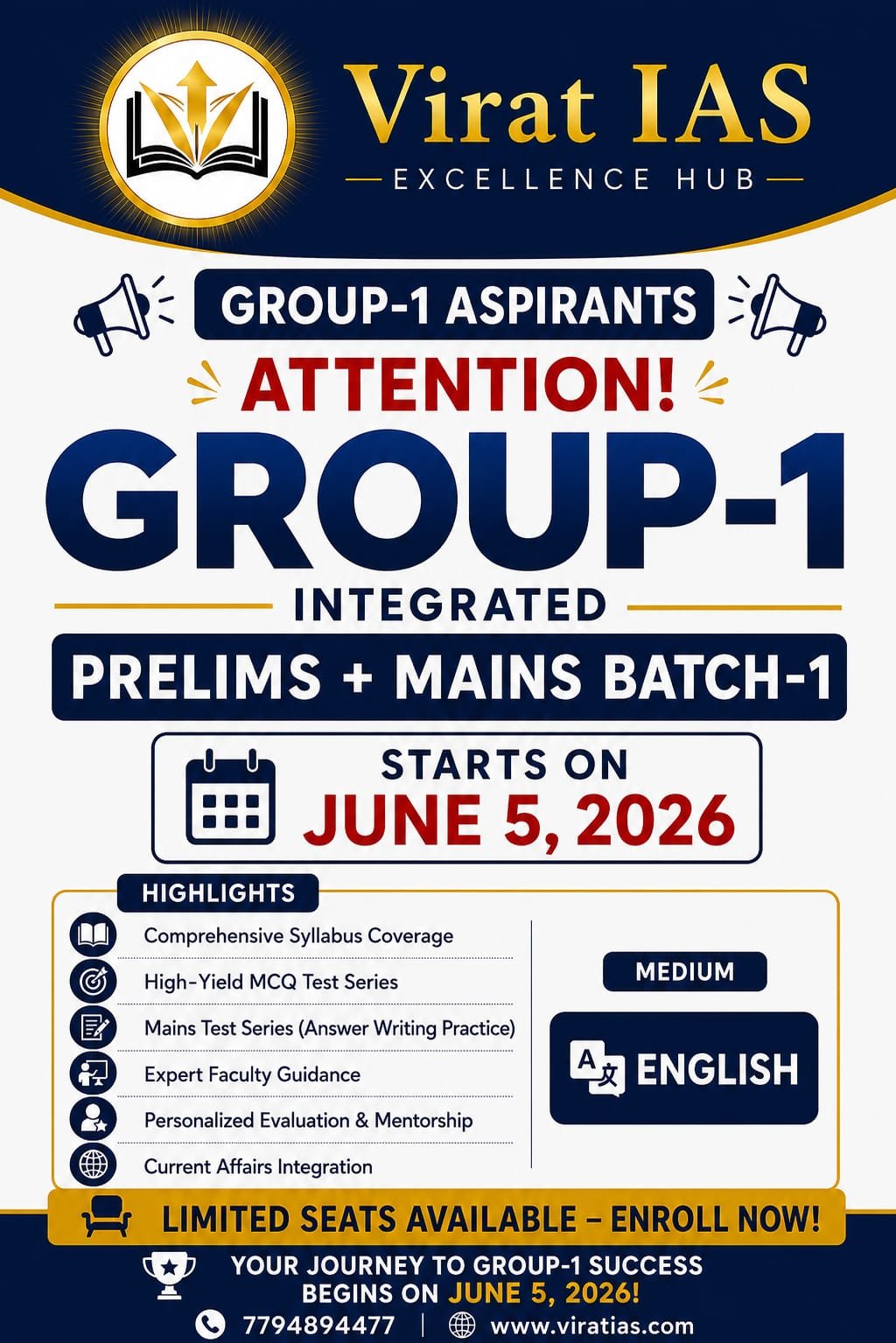
Enroll now for UPSC, APPSC & TGPSC and Test Series to boost your success with expert guidance and mentorship.

Enroll Now

UPSC Mains GS-III (Economic Development, Indian Economy, Science & technology, Environment, Bio-Diversity, Internal security, Disasters and Disaster Management).

Higher scores in UPSC Mains General Studies Paper 3 (GS-III) require a strategic blend of conceptual clarity, current affairs integration, and effective answer writing skills and this paper is highly dynamic in nature and expects understanding the concepts and its application in daily life.

  • I. High-Scoring Strategy & Skills :
    • A high-scoring strategy focuses on the dynamic nature of the paper and precise articulation.
    • Syllabus Decomposition: Break the official syllabus into micro-topics and map them to Previous Year Questions (PYQs) to identify high-yield areas and question patterns.
    • Current Affairs Integration: Almost every question in GS-III has a contemporary dimension. Link static concepts with current developments, government schemes, and policy changes in the introduction, body, and conclusion of your answers.
    • Structure and Clarity: Write concise, structured answers using flow charts and relavent facts and data:
      • Introduction : Define the concept or provide a recent context (e.g., a relevant news item or recent report.
      • Body : Use clear headings and bullet points to cover the core issues, causes, effects, challenges, and solutions.
      • Data and Examples : Incorporate relevant data, committee reports, case studies, and examples (e.g., successful government projects, local disaster management efforts, technological breakthroughs).
      • Conclusion : Provide a balanced, forward-looking/Way Forward or a summary with a governance/ethical perspective.
    • Diagrams and Flowcharts: Use simple, neat flowcharts, block diagrams, or maps (e.g., a cycle of inclusive growth, a diagram of a PPP model, a map showing internal security threats) to explain complex processes quickly.

II. Study Plan & Resource Material :

1. Core Resources :

Subject Area Standard Textbooks & Core Materials Current Affairs & Reports
Economic Development & Indian Economy NCERT Class 9 - 12, Indian Economy by Ramesh Singh, Economic Survey, Union Budget NITI Aayog Reports, PIB, The Hindu/IE, Yojana/Kurukshetra
Science & Tech NCERTs, Science & Tech by Kalpana Rajaram / Tata Mcgraw Hills Science Reporter, ISRO/DRDO/DBT updates
Environment & Ecology Shankar IAS, NCERT Biology (Ecology) ISFR, IPCC Reports, COP Summits
Internal Security Internal Security by Ashok Kumar, MHA/IDSA Cyber issues, Organized Crime & Terrorism linkages
Disaster Management NDMA Guidelines, IGNOU Notes, Disaster Mgmt by R.B. Singh Sendai Framework, Recent disasters

2. Study Plan Focus :

  • Static + Dynamic : Study static topics and immediately update them with current affairs and schemes.
  • Note-Making : Prepare crisp notes blend with concepts and current application (max 2 pages per topic).
  • Practice : Daily answer writing (2-3 questions).

III. Government Initiatives for Water Crisis Mitigation :

The Indian government has launched several major initiatives to mitigate the water crisis, focusing on conservation, sustainable use, and equitable distribution.

  • The Indian government has launched several major initiatives to mitigate the water crisis, focusing on conservation, sustainable use, and equitable distribution.
  • Jal Jeevan Mission (JJM) : Aims to provide Har Ghar Jal (piped drinking water) to every rural household by 2024..
  • Jal Shakti Abhiyan (JSA) : A time-bound, mission-mode campaign that focuses on five priority areas: water conservation and rainwater harvesting, renovation of traditional water bodies, borewell recharge, watershed development, and intensive afforestation. .
  • JSA: Catch the Rain (JSA: CTR): Encourages all stakeholders to create and maintain rainwater harvesting structures. .
  • Atal Bhujal Yojana (ATAL JAL) : Focuses on sustainable groundwater management in water-stressed areas of seven states (including Gujarat, MP, Maharashtra). It involves community participation. .
  • Mission Amrit Sarovar : Aims to create/rejuvenate at least 75 water bodies (Amrit Sarovars) in every district of the country. .
  • Namami Gange : Focuses on the pollution abatement and rejuvenation of the Ganga River, ensuring both Nirmal Dhara (clean water) and Aviral Dhara (continuous flow).

IV. Disaster Management: Andhra Pradesh & Mitigation :

  • AP Vulnerability : AP is highly vulnerable to cyclones, floods (especially in coastal regions and river deltas), and droughts in the Rayalaseema region.
  • Mitigation Strategies :
  • Early Warning Systems : Improved Doppler radars and collaboration with IMD for accurate and timely cyclone and flood warnings.
  • Coastal Protection : Construction of cyclone shelters and promoting mangrove plantation as natural buffers.
  • Water Management : Schemes like Neeru-Chettu (now integrated into other initiatives) focused on improving water conservation structures like check dams and farm ponds.
  • Community Preparedness :Training local communities, especially in coastal areas, to act as first responders.

V. Toppers Skills and mentor Guidance :

Disclaimer:

While all efforts have been undertaken to ensure the accuracy of data, this document does not provide any basis for legal claim and the management and the staff of Virat IAS Excellence Hub would not be liable for any discrepancy or changes effected by UPSC in the conduct of Civil Services Examination. Please satisfy yourselves about any terms and conditions from the official website and notification of the UPSC Civil Services Examination.

+91 77948 94477
+91 77948 94477
viratiascse@gmail.com